Our Painted Tipis Buffalo Teepees Spirit Lodge Lake Manitoba Tipis Boreal Land Painted Tipis Traditional Designs Contemporary Designs Metis Style Tipis Hunting Tipis Painted Logos Liners Liners Decorated Liners Poles and Stakes Tipi Poles Stakes, Lacing Pins Accessories Tipi Camping Tipi Care |

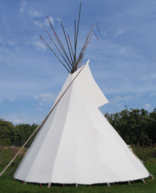 |
The conical shelter
known as wigwam has been used by the Eastern Woodland
Indians for millennia. The wigwam was a pole frame covered
with large sheets of birch bark. When tribes such as the Sioux,
Arapaho and Cheyenne moved to the Great Plains, they had to adapt their wigwam to a
new way of life. Birch bark was not longer available, it was
replaced by buffalo hides. Smoke flaps were also
added to keep winds from blowing into the tipi. The tipi was
a comfortable shelter. It could be taken down quickly, packed
onto a travois, and put up again elsewhere in no time. The traditional tipi is not a true cone, it is tilted, leaning back a little. Its floor plan is shaped much like an egg, longer from back to entrance, shorter from side to side. The location of fireplace is off-center, closer to the door, leaving more useable space at the back of the lodge. There are several known tipi styles, some are based on a 3-pole foundation, others have a 4-pole foundation. One last comment about the teepee! This is not like any other tents. Fact is, it is more like a sanctuary, a connection to Mother Earth, please treat your tipi accordingly! |
Hand Made, Well Made, Strong
Made
|
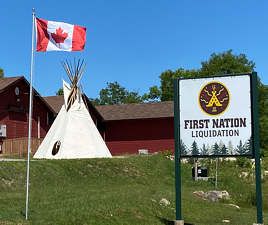 Our teepee at Muskoka First Nation, ON Photo North45 Communications Inc |

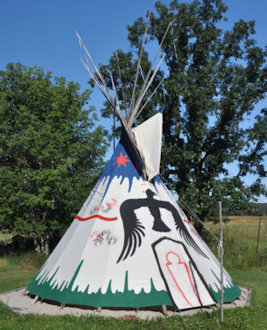
| A Tipi Has 4 Components. Choose each one separately to fit your needs - A tipi cover, it comes in two styles and many sizes - A liner, like a shorter wall inside the tipi, important but not alway necessary. - Poles, stakes and pegs - Artwork!. Not a component per say, but looks so great! |
 Shared Teepee Happiness |
|
How to Order, Step by
Step! Step 1 - Choose Your Tipi Style Woodland vs Grassland Tipi Both teepee styles are based on tripod frames, however the Woodland Teepee has shorter but higher smoke flaps while the smoke flaps of our Grassland Teepee are longer and narrower. Which One To Choose? Their names say it well, the Grassland is a good choice for open lands, it is also better for coastal areas. The Woodland Teepee is better suited for wooded places, the boreal forest, and the tundra. |
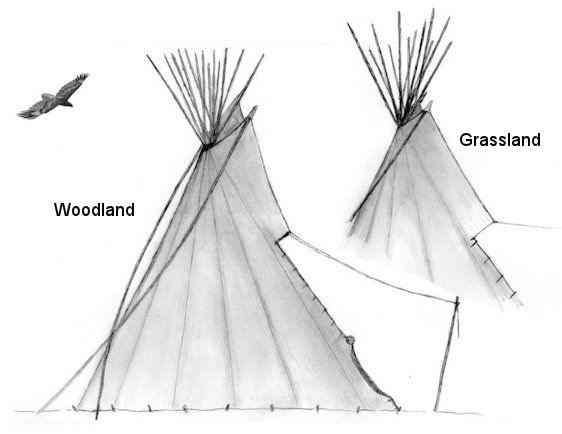 |
 Woodland Style |
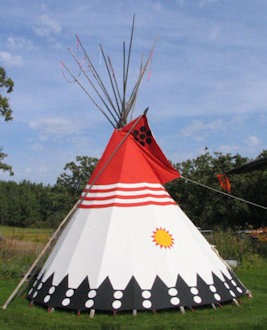 Grassland Style |
| Step 2 - Choose A Tipi Cover Our tipi cover also comes with its storage bag, a traditional door cover, all needed ropes, a smudge stick, some ribbons to decorate your poles, a CD with step-by-step instructions, and a booklet about Native American Tipis. Prices are in Canadian Dollar. |
 |
|
Free Gift with Tipi Purchase* The Tipi, Portable Home of the Plains Indians This saddle-stitched pamphlet provides a description of how different tribes made their now-iconic dwellings, how they used them historically, why they were so important to the culture of the Plains tribes, and how people still use tipis today. Illustrations and photographs in this handy and concise booklet help you understand the refined simplicity of these structures. 16 pages. |
| *Our welcome gift package also includes our instructional CD, sage for the smudging ceremony, and ribbons for your poles. |
|
| Step 3 - Proceed with a
liner, click here Step 4 - Skip the liner, and look for poles, click here Step 5 - To look at our painted tipis, click here To visit our Native American Gallery, click here |
| Assiniboine Tipis is a proud supporter of these Aboriginal associations |
   |
Assiniboine Tipis
PO Box 649, Lundar, Manitoba R0C-1Y0
Phone: (204) 762-5523
Canada
Contact Us |
About Us | Policy